

Philip Hergel
Senior Quantitative Analyst
“Lean on me, when you're not strong; And I'll be your friend; I'll help you carry on; For, it won't be long; 'Til I'm gonna need; Somebody to lean on”
Bill Withers' 1972 song "Lean on Me" captures a universal truth about friendship and collaboration: I'll help you when you're having troubles and I know you'll help me. Friendship is inherently reciprocal. That notion of mutual reliance seems lost these days, potentially resulting in a retaliatory international movement to "sell America". (Chart 1)
The Geopolitical Rupture
Download the full piece here.
In January 2026, Canadian Prime Minister Mark Carney, while addressing the World Economic Forum in Davos, Switzerland, described the post Cold-War international order as undergoing a definitive and lasting “rupture.” He described powerful countries as using “economic integration as coercion,” along with “tariffs as leverage” and he urged “middle powers” to develop greater autonomy and strengthen relationships with other like-minded nations to uphold shared values, because “if you’re not at the table, you are on the menu.”
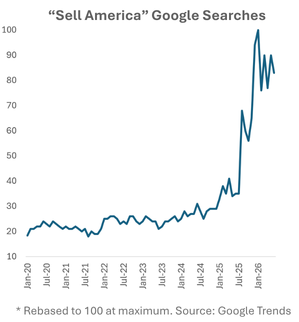
Chart 1
Without explicitly referencing Donald Trump or America’s current domestic and foreign policies, many interpreted his remarks as a signal that Canada and other “middle powers” should no longer rely on its longstanding ally to the same extent as in the past. Carney reinforced that message in June this year by announcing plans to expand Canada’s submarine fleet through purchases from German defense firm ThyssenKrupp Marine Systems rather than from U.S. suppliers. This international trade development is one example of the “sell America trade” and more importantly it reflects the current geopolitical environment dictated by the current U.S. administration.
What is the “Sell America Trade”
Selling America is more than simply an explicit financial market transaction. It is a broad conceptual framework of behavior to express one’s dissatisfaction with the manner in which the United States of America is currently conducting itself on the global economic and geopolitical stage.
While it’s true this might indeed involve selling U.S. financial assets, it also encompasses a broader scope of decision making. Some obvious and recent examples of how to “sell America” are the following:
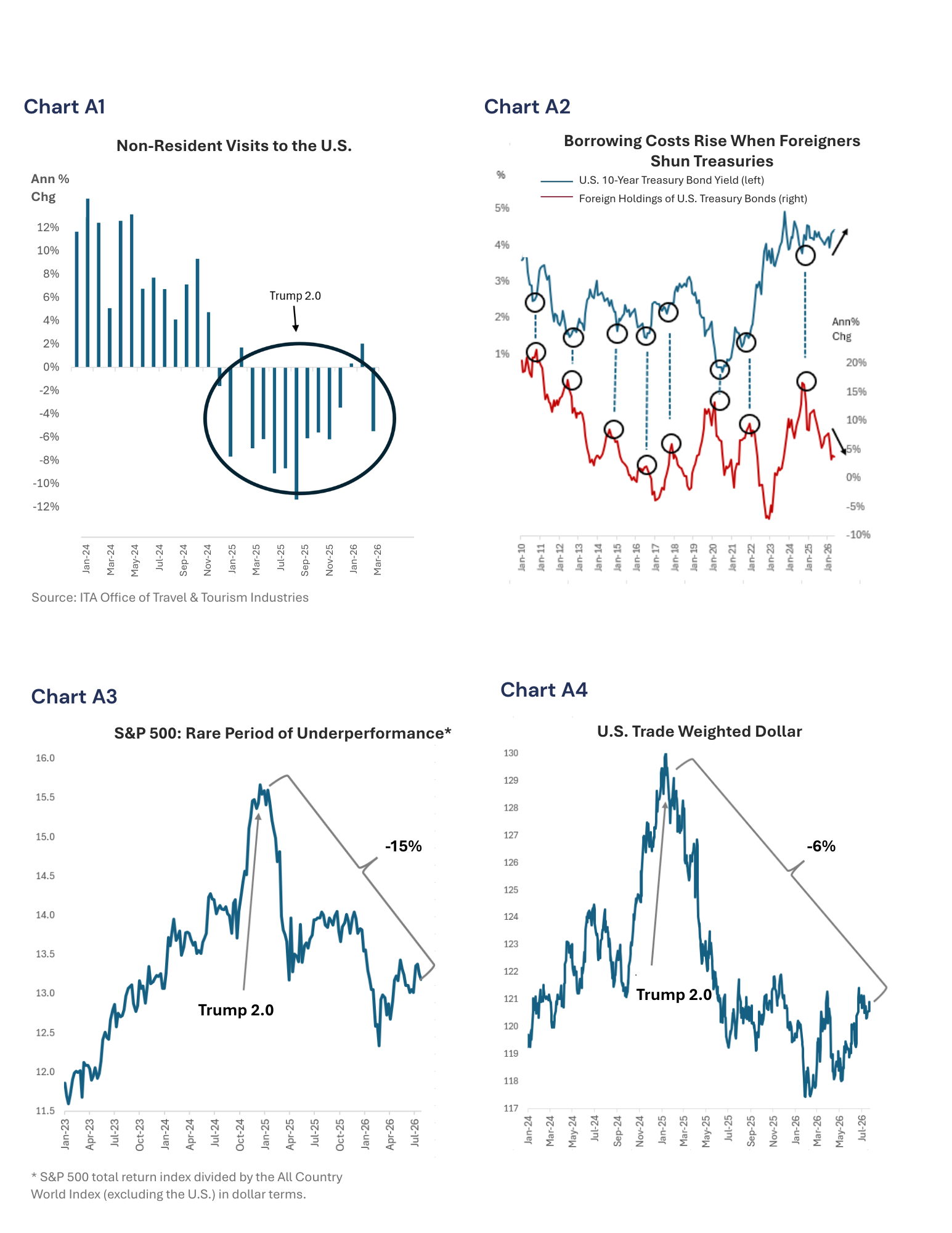
Since Trump's second term began, tourist visits and tourism revenue have weakened dramatically, with visits below year-earlier levels in all but 3 months since January 2025.
There is also considerable anecdotal evidence that foreign owners of U.S. real estate are increasingly choosing to either rent out or leave vacant their second homes located in the United States.
This administration is making higher education less welcoming to foreign-born students, and as a result talent is choosing to study elsewhere. According to Bloomberg, international student enrollment is down by almost 20% in the last academic year.
Global central banks are increasingly building up gold reserves and reducing U.S. dollar reserves as a form of protection against broad and sustained dollar depreciation.
Regional payment systems are gaining popularity as a means to reduce dependence on the U.S. dollar. Several systems are currently under consideration or in development in the BRICS (Brazil, Russia, India, China, South Africa), ASEAN (Association of Southeast Nations), and PAPSS (Pan-African Payment and Settlement System).
The removal of U.S. products from foreign shelves, such as American whiskey from Canadian liquor stores and Harley Davidson motorcycles from European showrooms. China has also dramatically reduced purchases of U.S. soybeans and other agricultural products in response to tariffs imposed on Chinese goods.
Explicit “sell America” examples in the financial markets include selling or underweighting U.S. domiciled publicly traded companies resulting in underperformance of U.S. equity benchmarks, as well as foreigners reducing or slowing the purchase of U.S. treasury bonds as well as U.S. corporate bills, notes and bonds. The aggregate result of all these “sell America” trades is for the U.S. dollar to depreciate in value. See the appendix for graphical representation of some of these “sell America” examples.
Why “Sell America”?
The emerging “sell America” trade is rooted in a growing perception abroad that the United States has become less predictable and trustworthy and therefore a less attractive destination to allocate capital. The latest sweeping Section 301 tariffs imposed on 60 trading partners is the latest measure straining relations with former allies, who increasingly view U.S. policy as favoring short-term domestic political objectives over the stability of the global trading system.
Political uncertainty has compounded these concerns. Frequent policy reversals and increasingly polarized policy decisions have created a sense that the United States is no longer the reliable leader of the international order as Canadian Prime Minister and other world leaders have highlighted. Many investors also worry that political pressures could intrude into financial markets and institutions, eroding confidence in the impartiality of the U.S. capital system. The U.S. government taking financial stakes in several U.S. publicly traded companies such as Intel and MP Materials as well as voting rights in U.S. Steel are perfect examples of why this concern about impartiality is warranted.
Questions surrounding the independence of the Federal Reserve have added to this unease. Although the Fed remains one of the world’s most respected central banks, recurring political criticism and reduced transparency regarding the future path of monetary policy have led some foreign investors to question the durability of its independence. Meanwhile, persistent budget deficits and rapidly growing national debt have fueled fears of fiscal recklessness and the possibility of higher inflation and/or heavier taxation in the future.
Valuations in U.S. equity markets are also a valid concern. After years of exceptional performance, many American stocks trade at premiums relative to their international counterparts, prompting investors to seek better value elsewhere. As confidence in U.S. exceptionalism wanes, capital is flowing on the margin toward markets perceived as offering a more attractive balance of risk and return.
“ “If the U.S. cannot be trusted to tackle the clear existential threat of climate change, why should outsiders trust the U.S. in other matters?””
Finally, many countries are frustrated by what they see as America’s inadequate response to the defining long-term challenge of our era: global warming. The reality that the United States has not consistently embraced ambitious climate policies has weakened its moral authority and provided more reasons for other nations to pursue independent economic and financial strategies. Essentially, if the U.S. cannot be trusted to tackle the clear existential threat of climate change, why should outsiders trust the U.S. in other matters?
Taken together, these developments have contributed to a reassessment of the role U.S. assets play in global portfolios. Whether the “sell America” trade proves temporary or enduring will depend on the nation’s ability to restore confidence in its institutions, fiscal discipline, and commitment to international cooperation.
Consequences of “Sell America”?
The consequences of a sustained global "sell America" trade could extend far beyond portfolio rebalancing and financial markets. Sustained foreign selling of U.S. equities would likely depress equity returns, while reduced demand for Treasuries would push government borrowing costs higher, worsening the fiscal position and raising borrowing costs throughout the domestic economy. Likewise, rising corporate bond yields would increase financing costs for businesses, reducing capital expenditures and slowing economic growth. Diversification away from dollar-denominated assets would also weaken the U.S. dollar, eroding Americans' purchasing power and increasing domestic inflationary pressures through higher import prices.
“ “American exceptionalism without the exceptional is a heavy lift!””
The broader effects could be equally significant. International students, researchers, and skilled workers might increasingly choose other destinations, slowing the inflow of talent that has long fueled American innovation and entrepreneurship. American exceptionalism without the exceptional is a heavy lift! Tourists could further redirect their travel spending to countries perceived as more welcoming or stable, hurting hospitality and related industries. Foreign firms might likewise favor investing elsewhere, reinforcing a cycle in which economic opportunities, capital, and human talent increasingly flow outside the United States. Over time, a pervasive "sell America" dynamic would represent not merely a market adjustment, but a gradual erosion of the economic and institutional advantages that have underpinned U.S. prosperity for decades.
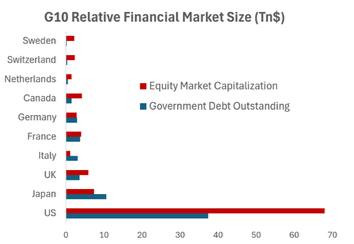
Chart 2
Fortunately, the case for a sustained global "sell America" trade is far from a foregone conclusion. The United States is home to the deepest and most liquid financial markets in the world, making it difficult for global investors to meaningfully shun U.S. assets (Chart 2). U.S. Treasury securities remain the global benchmark for risk-free assets, while the U.S. equity market accounts for over 50% of global market capitalization. Equally important, the United States remains unrivaled in the dynamic, innovative, and entrepreneurial spirit of its economy, helping to explain the market's long-standing "buy the dips" mentality. Consequently, while "sell America" sentiment clearly exists and warrants attention, a widespread, persistent, and intensifying exodus from U.S. assets is not the most likely intermediate-term outcome.
The Bottom Line
Enduring prosperity and leadership rest not on coercion and/or isolation, but on trust, reciprocity, and a willingness to work with others toward common goals. The United States has long benefited from alliances, openness to talent, and confidence in its institutions. Preserving those strengths will require a renewed commitment to cooperation at home and abroad. If America expects other nations to continue investing in its markets, partnering with its businesses, welcoming its products, and embracing its leadership, it must demonstrate that it is a reliable, and principled partner.
Acting with greater humility, consistency, and respect for shared interests is not simply a moral aspiration—it is a strategic imperative to avoid accelerating the "sell America" mindset that extends well beyond financial markets. In an interconnected world, even the most powerful nation cannot prosper alone. As Bill Withers so memorably reminds us, there will come a time when we all need “somebody to lean on.”
Disclosures: Registration with the SEC should not be construed as an endorsement or an indicator of investment skill, acumen or experience. Investments in securities are not insured, protected or guaranteed and may result in loss of income and/or principal. This communication is distributed for informational purposes, and it is not to be construed as an offer, solicitation, recommendation, or endorsement of any particular security, products, or services. Nothing in this communication is intended to be or should be construed as individualized investment advice. All content is of a general nature and solely for educational, informational and illustrative purposes. This communication may include opinions and forward-looking statements. All statements other than statements of historical fact are opinions and/or forward-looking statements (including words such as “believe,” “estimate,” “anticipate,” “may,” “will,” “should,” and “expect”). Although we believe that the beliefs and expectations reflected in such forward-looking statements are reasonable, we can give no assurance that such beliefs and expectations will prove to be correct. Various factors could cause actual results or performance to differ materially from those discussed in such forward-looking statements. All expressions of opinion are subject to change. You are cautioned not to place undue reliance on these forward-looking statements. Any dated information is published as of its date only. Dated and forward-looking statements speak only as of the date on which they are made. We undertake no obligation to update publicly or revise any dated or forward-looking statements.