

Senior Equity Analyst
A few years ago, the word "token" meant a subway coin or an arcade chip. Today, it means the basic unit of measurement in the artificial intelligence industry. Every time a business uses AI, it is charged by the token consumed – the same way a business is charged by the kilowatt-hour (kWh) for electricity. In this memo we explain what tokens are, how the token business works, the price war we believe is now beginning, and why it is relevant for stock markets.
What is a Token?
When you ask an AI system like ChatGPT or Claude a question, the model breaks your question into small chunks called tokens. Your question goes in as tokens; the answer comes back as tokens. Every AI interaction is measured by the tokens consumed and created. Tokens are also how AI is billed: companies pay for AI use by the token, the way consumers pay for electricity by the kilowatt-hour. When ChatGPT launched in late 2022, no one thought about the creation of a token economy. Now that businesses utilize AI every day, tokens have become the utility meter on the corporate wall.
Download the full piece here.
The Recipe: Power + Chips + Models = Token
The AI industry runs on a simple equation:
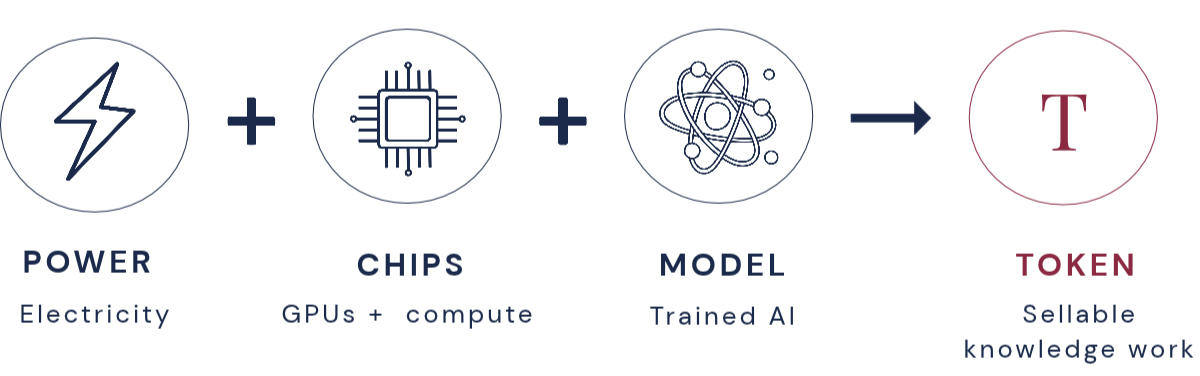
AI companies and their models can be seen as refineries; they take in electricity and computing capacity and turn out knowledge work. Their customers – software companies, banks, retailers, and increasingly every kind of business – buy tokens as an operating cost, treating AI as an extension of the workforce or a solution to a business. It is a category of expense that did not exist on any company's books three years ago.
What Are We Really Buying When We Buy a Token?
Our interpretation: we are buying knowledge work. What AI companies sell is reasoning, writing, coding, and analysis - the type of work that could only be performed by humans in the past. Now that capability lives inside the AI model, the token is simply how it is delivered and billed. The token is the measurement, and the knowledge work embedded in it is the product.
Here are some observations: First, not all tokens are created equally. A kilowatt-hour of electricity is identical no matter who generates it, but a token is only as good as the model that produced it. A token from the best frontier model carries better judgment than a token from a less advanced model. The right unit of comparison for a buyer is, therefore, not the price per token but the cost per completed task. Second, building a leading model costs billions of dollars up front. Once built, each additional token costs very little to produce. Thus, the temptation to cut prices to win customers is constant and structural. Third, if we arrive at a time in the future when competing models eventually converge at a similar level of capability then tokens really do become like electricity - interchangeable - and no AI company will be able to charge a premium.
Cheaper Tokens but Bigger Bills
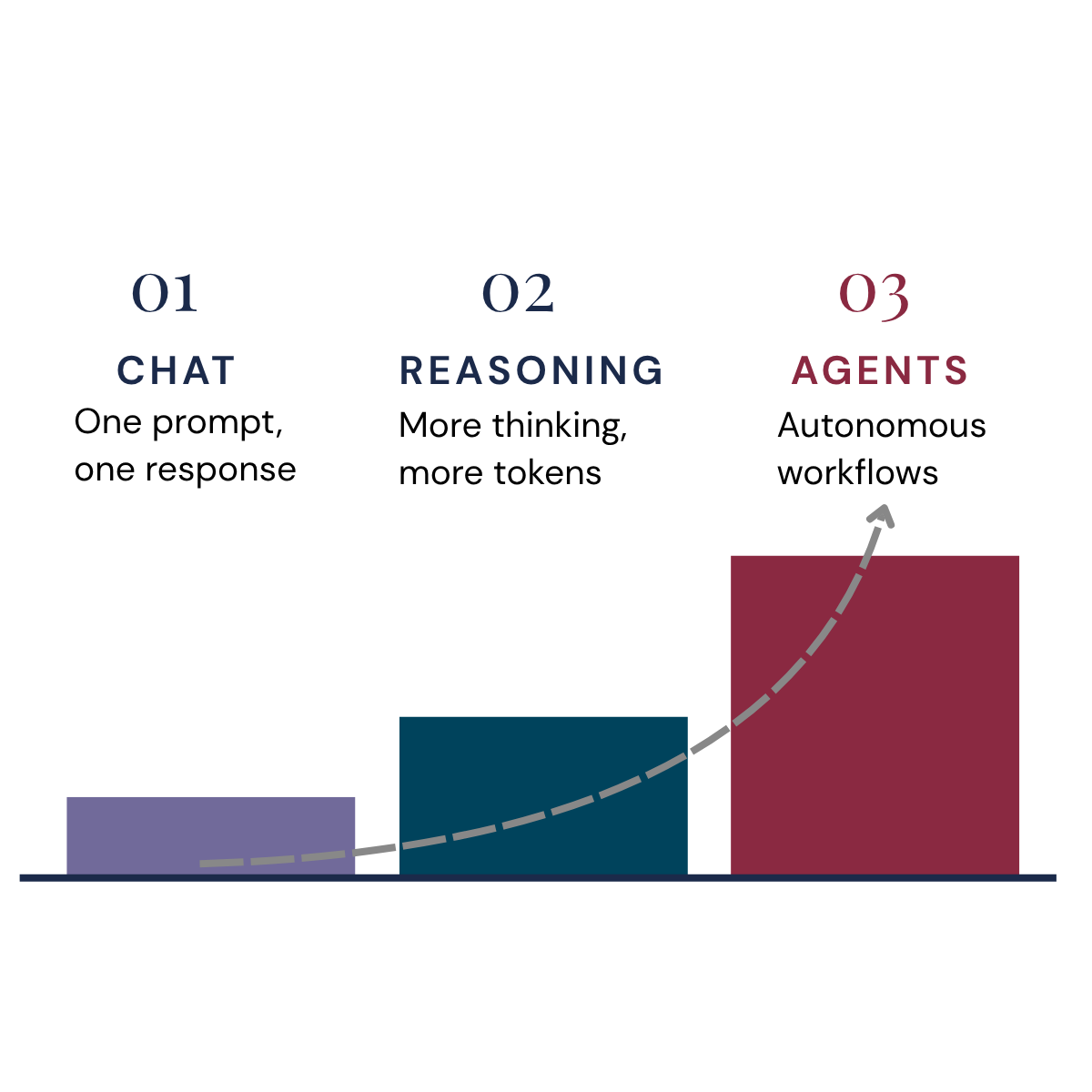
From a simple chat to autonomous agents, each steps consumes dramatically more tokens
Demand for tokens has evolved through three inflection points. ChatGPT proved that a large language model (LLM) was a useful tool for numerous applications. Reasoning models then showed that more tokens produced better answers. Then, AI agents changed the scale entirely.
AI agents are now doing research on a topic, planning the steps, using software tools, and checking their own work. An autonomous agent completing a single comprehensive workflow can consume hundreds of times the tokens of a simple chat prompt. Bigger jobs, bigger bills. Businesses have started to push back on these costs. Large companies are now capping AI spending per employee, automatically directing routine work to cheaper models, setting token budgets, and assigning staff to scrutinize AI bills. That pushback has set the stage for what happens next.
We Believe a Token Price War Is Coming
For the last three years, every major AI model launch focused on capability. We were fascinated by what new models could do versus previous versions. Price and efficiency were an afterthought. In recent months, SpaceX, OpenAI, and Meta each released new models, and each led their announcement with the same metric: the cost per token. We believe the competitive frontier is shifting from raw capability to efficiency and cost. Companies such as SpaceX and Meta both own their compute infrastructure and subsidize AI costs through their other businesses. The leading AI labs, OpenAI and Anthropic, by contrast, rent their compute from cloud providers and pay a markup on tokens generated. When a company owns the compute servers, it can afford to cut prices in ways renting competitors cannot. This is the same dynamic that made Amazon's cloud business so dominant a decade ago, and it means the price war may hit some players much harder than others.
What Does This Mean For Your Portfolio?
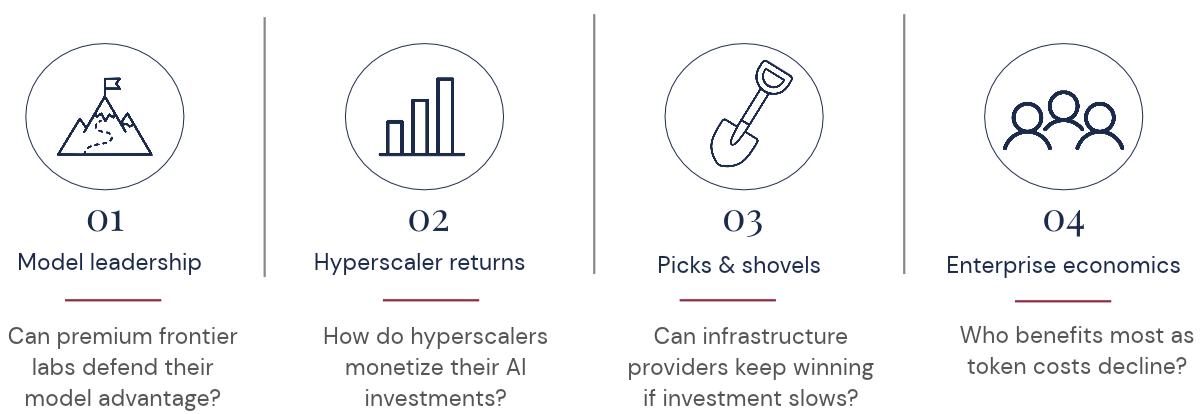
We are watching four things. First, whether premium AI frontier labs such as OpenAI and Anthropic can defend their model superiority, or whether cost and efficiency-focused challengers such SpaceX, Meta, and Chinese models take real market share. Second, how do leading hyperscalers such as Microsoft, Alphabet, and Amazon track their return on investments and monetization? Third, can the companies that supply the industry's picks and shovels (i.e., chips, memory, power equipment) continue to be winners if AI investment slows? Fourth, how do enterprises that pay for these tokens react to these trends? Falling token prices should improve the economics of enterprises – a benefit, we believe, the market does not yet fully appreciate.
As always, we favor quality businesses with durable advantages and sensible valuations over bets on any single technological outcome. That approach matters more than ever right now, with roughly a third of the S&P 500's index sitting in companies whose fortunes are tied to how the token economy develops. We own a diverse group of these AI beneficiaries – hyperscalers, data center operators, picks and shovels suppliers – and we continue to monitor the space. It is a young market, fast moving, and genuinely uncertain – which is exactly why we remain diligent in these investments.
Disclosures: 1. Registration with the SEC should not be construed as an endorsement or an indicator of investment skill, acumen or experience. 2. Investments in securities are not insured, protected or guaranteed and may result in loss of income and/or principal. 3. Historical performance is not indicative of any specific investment or future results. 4. Views regarding the economy, securities markets or other specialized areas, like all predictors of future events, cannot be guaranteed to be accurate and may result in economic loss of income and/or principal to the investor. 5. Unless stated otherwise, any mention of specific securities or investments is for illustrative purposes only. Adviser’s clients may or may not hold the securities discussed in their portfolios. Adviser makes no representations that any of the securities discussed have been or will be profitable. 6. Certified B Corp status is, at least in part, based on responses provided to B Lab by Zevin Asset Management. ZAM pays annual membership dues to B Lab, which is a requirement for eligibility in B Lab results. Certified B Corp status requires an assessment of companies’ positive impact on workers, community, customers, and environment.