
2026 Impact Report
Our engagement work 2024-2026
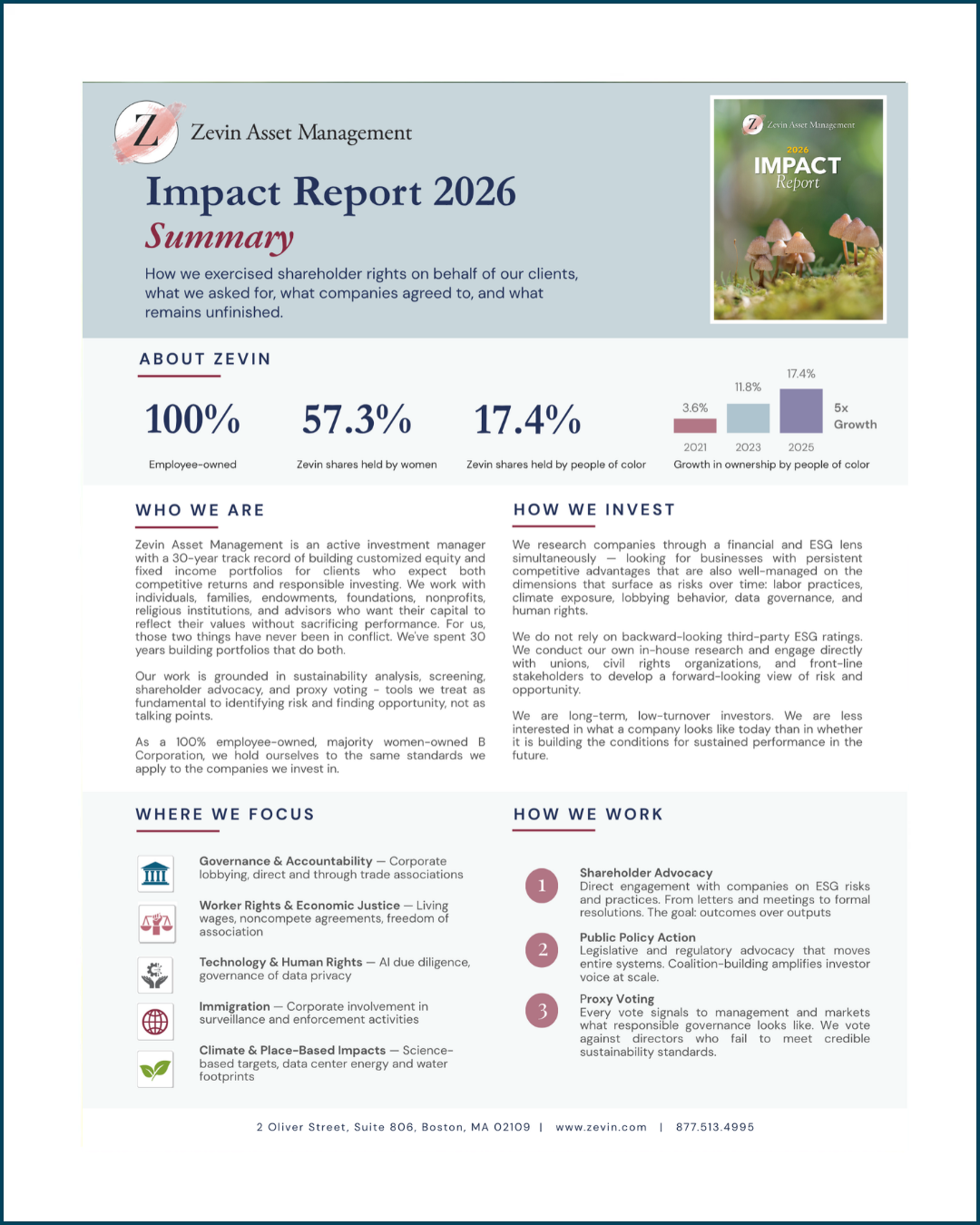
2026 Impact Report Summary
2-page summary of our engagement work
Our 2026 Impact Report documents two years of engagement work and how we exercised shareholder rights on behalf of our clients. What we asked for, how companies changed, and what remains unfinished.
Download the report to read about our work on technology and human rights, climate risk, worker rights, and corporate lobbying accountability, set against a regulatory and political environment that has made this work harder, and more necessary.
A Note on Zevin Asset Management’s Impact Report 2026
Sonia Kowal
President
Sustainable investing is often described as a preference. In moments like this one, it is better understood as a discipline.
The past two years have tested that discipline in ways that were foreseeable and in ways that were not. Anti-ESG legislation advanced in dozens of states. The SEC walked back climate disclosure rules and made it easier for companies to exclude shareholder proposals from proxy ballots without regulatory review—effectively turning the regulator into a bystander and handing management a new tool to silence investors. The current administration has moved aggressively to redefine fiduciary duty as a mandate for short-termism, severing it from the systemic risks that any serious long-term investor must account for. These are not abstract policy shifts. They are deliberate constraints on the mechanisms of shareholder democracy.
““Durable investment returns depend on the health of the underlying system.””
We do not view these conditions as a reason to retreat from our principles.
Our approach has always been grounded in a simple belief: that durable investment returns depend on the health of the underlying system—how companies treat their workers, manage risk, govern themselves, and respect the communities and environments in which they operate. These are not political considerations. They are fundamental components of long-term value creation and risk management. Responsible investing does not mean avoiding difficult conversations. It means engaging when it is easier not to, exercising shareholder rights persistently even when those rights are contested, and remaining invested in the work of improvement rather than opting for symbolic exits. Equity and accountability are the terms on which durable markets are built. Some of the most important outcomes of active ownership are risks avoided rather than headlines earned.

The work is ongoing, and even more urgent than it was two years ago when our last impact report was published. Central to our approach are our long-standing stakeholder relationships. Unions, civil rights advocates, immigrant rights groups, and community-based institutions whose expertise and lived experience inform how we understand risk, opportunity, and impact. These partnerships keep our research honest and our priorities sharp. We don’t view these relationships as supple- mentary to our investment process; they are central to it.
We are grateful to the clients and partners who share our conviction that responsible investing is not a trend to be managed, but a responsibility to be upheld— especially when it is challenged.